- GM Frens Lootbox
- Posts
- Why Web2 Marketing Stack Does NOT Work For Web3
Why Web2 Marketing Stack Does NOT Work For Web3

Manuel Olumorin
January 11, 2023
GM GM. We bring some spicy loot today. Let's get to it.
If you are early, should you use paid ads
The Sneakies
Should You Use Paid Ads For User Acquisition
So you have a new game, Super Crypto Smash Bros, and you want to get the game into players' hands.
You say to yourself, "I've done this before in my days building Web2 games." Let's pull out the playbook - run ads on Facebook and Instagram targeting similar games, and add in the app stores to boot.
You quickly realize, this ain't gonna work.
Let's break down why many Web3 games have struggled to get ROI (return on investment) on their ad dollars, especially early-stage games.
Why paid acquisition has not been as successful, yet
1/ Web3 breaks the typical Web2 conversion path
The typical conversion path for paid acquisition is advertising on one of the big ad platforms like Facebook and Google, then driving the traffic to a central point (a landing page) where the user converts. Once they convert, all their actions are within your walled garden.

Web3 breaks this frame, making the conversion path very different. Users can mint your NFTs on your website, P2P (a direct exchange) or a marketplace like OpenSea. They could buy your token off a centralized exchange like Coinbase or Binance, or they could get it on a DEX like Uniswap. All this is done before getting into your game.
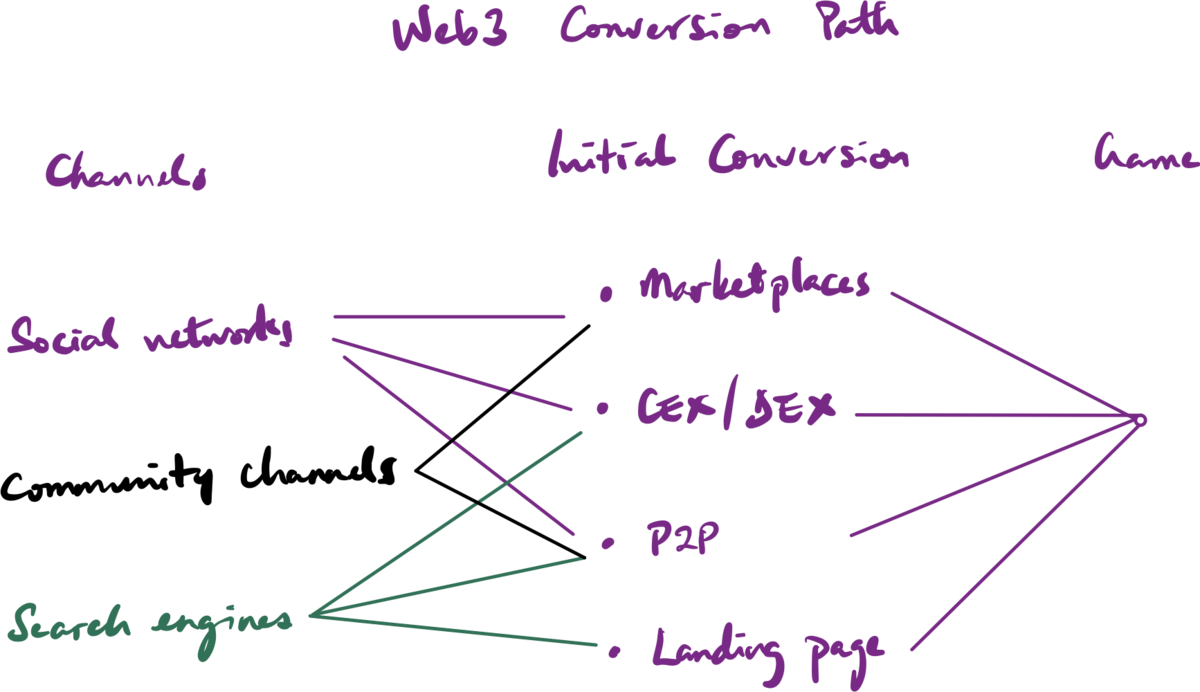
2/ Channels where you can reach Web3 users
Where do Web3 users hang out? Twitter, Discord, Telegram.
These channels, except Twitter, are not central locations where users congregate. The users are broken into smaller communities within these platforms. In the case of Twitter, their ad platform does not have the same targeting effectiveness as a platform like Facebook. What this does is leave you with little to no programmatic options to reach your target audience.
3/ The attribution problem
Understanding your marketing effectiveness has been one of the biggest unlocks of marketing in Web2. You know your marketing metrics, ROAS (return on ad spend), LTV (lifetime value), CPI (cost per install) and more that help you make better decisions. You got this because your walled garden's data is tied to the marketing channels. Despite that, there is difficulty attributing each channel's contribution to conversion because of users' cross-channel behaviour.
Web3 adds to that complexity with the new conversion path. Did OpenSea showing your NFT on their Top 10 trending list drive more users to your game, or did your ad dollars do it?
What to do then
As Paul Graham once said, do things that don't scale. Web3 is about communities, and at this time, we are unable to reach segmented communities programmatically. So try what others are experimenting with.
1/ Social proof marketing
This leverages what Robert Caldini calls "wisdom of the crowd." The psychology behind it is people are more likely to do something when they see other people have gone before them.
In what ways can you do this?
User-generated content: Get your early users to become content creators, making content such as live reactions to your gameplay or educational materials for your game. You can reward these off-game actions with your tokens or NFTs.
Create scarcity for access: The Stepn team absolutely crushed it using this method. They restricted access to playing their game using referral codes. This created scarcity (giving users the perception of high demand when they could not get a code) and the added benefit of controlled scaling.
2/ Partnership marketing
Suppose you know how the Facebook Lookalike audience works. In that case, you'll know it uses the nearest neighbour algorithm to determine the affinity of users on their platform compared to your audience. The stronger the affinity, the more likely they'll convert to your game.
Communities work similarly. Each community has an affinity with other communities. If a community has a similar product or an audience you think would like to try your game, this is an excellent place to start building partnerships that drive users to your game. You could measure the conversion compared to the size of the community and retention as proxies for community affinity.
3/ F2P playbook
If you are taking the F2P path and going after mainstream gamers, marketing through existing Web2 channels makes sense. What changes in your free-to-paying user conversion is how you convert the user into a Web3 user. Most of your focus would be on educating the user through the conversion.
Not an exhaustive list but good places to start.
Is hope lost on a programmatic approach for Web3?
No!
The Web2 era went through a similar process, slowly building out tools. @safaryclub showed the progression of Martech from 2011 - 2019.
📈 Web2 Marketing Tech took off like wildfire.
There were 150 companies in 2011 and there are 10K+ today.
@chiefmartec has documented this evolution annually.
Web3 Growth Tech is growing even faster.
It's a HUGE opportunity for investors & builders. http
— Safary 🦁 (@Safaryclub)
4:34 PM • Oct 12, 2022
This is what it looks like for Web3 currently.
The market for web3 growth tools is heating up 🔥
75+ teams are working on growth analytics, attribution, community, messaging, adtech, crm, & incentives.
We canvased the industry so you don't have to.
Introducing: The Web3 Growth Technology Landscape🧵 http
— Safary 🦁 (@Safaryclub)
4:34 PM • Oct 12, 2022
Seeing more tools created is a certainty, so is programmatic marketing for Web3.
The Sneakies
Love this email?
Please forward it to a friend who needs to read this.